Shop

Take the ideas home. Most of it is free.

The ebook of What If You Live?, plus free apps, guides and word finders you can use and share.
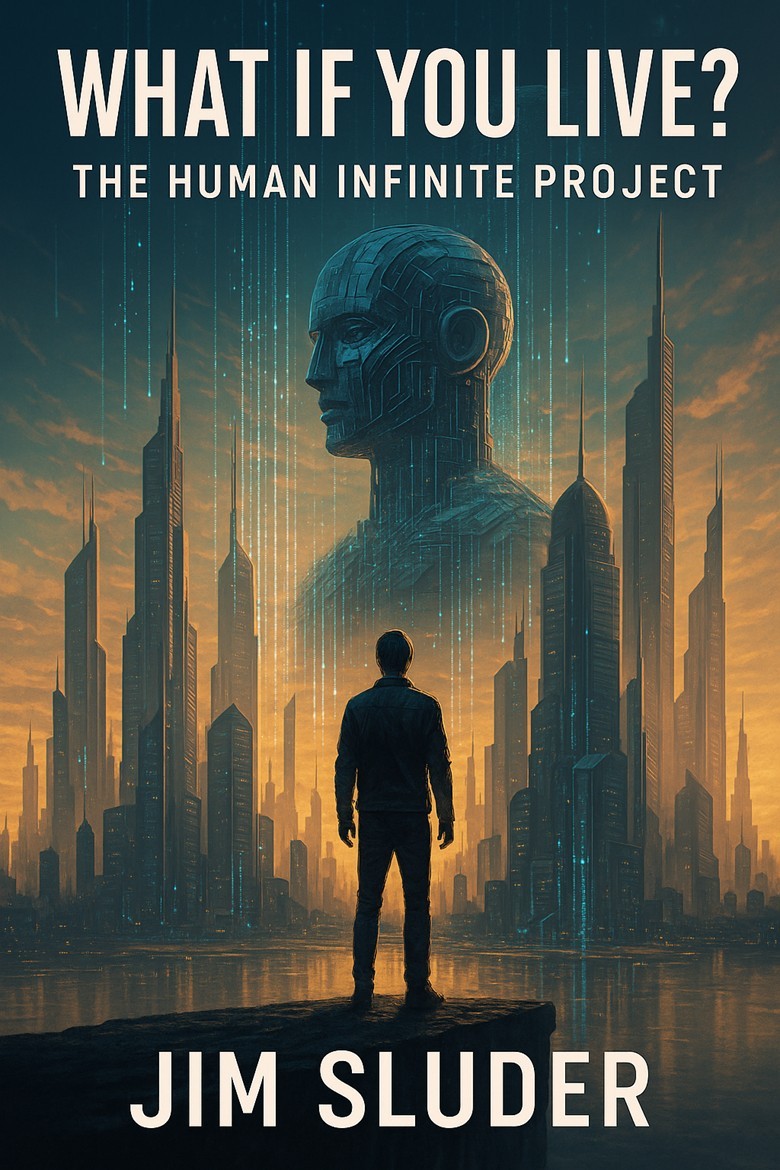
Cover of What If You Live? The Human Infinite Project, by Jim Sluder

The book behind the project

What If You Live? — the ebook

How AI will touch every part of society, why our institutions will need to grow to keep pace, and how we can make sure no one is left behind.

$4.00

Online checkout is coming soon. Until then, send a note and we’ll get you a copy.

Free apps & guides

Free to use. Free to share.

Short, self-paced guides and handy references you can use in any order. They work on a phone, need no account, and cost nothing.

AI tools & the future

App

Cogniscope One

A research workbench for studying how AI models behave in conversation. Private: nothing leaves your computer.

Open the app →

Guide

Building an Expert Agent with Hugging Face

Build your own expert AI assistant step by step with free tools.

Start reading →

Guide

Post-Scarcity

Could technology end want for good? The strongest case on each side, laid out fairly.

Start reading →

Guide

Longevity Escape Velocity

Can medicine outrun aging? What the science shows and what’s still argued.

Start reading →

Science & the natural world

Interactive

The Solar System

One star, eight planets, and an enormous amount of nothing, with a true-distance map.

Start exploring →

Guide

Astronomy

How we learn so much from starlight alone, and how to start looking up.

Start reading →

Guide

Oceanography

Why the sea is salty, how currents, waves and tides work.

Start reading →

Guide

Weather

Highs and lows, clouds, fronts and storms, and how to read a forecast honestly.

Start reading →

Guide

Geography

Why things are where they are: maps, rivers, cities and borders.

Start reading →

Interactive

The Body You Live In

A head-to-toe tour of your body’s parts and systems.

Start exploring →

Animals

Guide

Dogs

How dogs think, learn and communicate.

Start reading →

Guide

Cats

What cats really need, and how to spot the illnesses they hide.

Start reading →

What’s It Called? — 16 word finders

No. 1

Mathematics

Sum, slope, median, derivative, and how to say every symbol out loud.

No. 2

Physics

Mass versus weight, torque, entropy, voltage: pairs that sound alike and aren’t.

No. 3

Chemistry

Moles, bonds, acids and bases, and how to read a formula or a safety sheet.

No. 4

Biology

Cells, genes, evolution and ecology, from the smallest level up.

No. 5

Computer Science

Bugs, databases, networks and security, in words that get you real help.

No. 6

Engineering

Tolerances, loads, safety factors, and who signs off that it’s safe.

No. 7

Business & Finance

Profit versus cash, APR, margins, taxes, and the words used to persuade you.

No. 8

Research

How to tell a finding from a claim, and read a study without a statistics course.

No. 9

Listening & Conversation

Name the move while it’s happening, and learn what to say back.

No. 10

Artificial Intelligence

Models, tokens, alignment, AGI: the field’s words, including the contested ones.

No. 11

Philosophy & Ethics

The frameworks, the big questions, and the famous thought experiments.

No. 12

Government, Policy & Law

Statutes, regulations, courts and rights, and where ordinary people have a voice.

No. 13

Media Production

Camera, sound, editing, writing, and the rights that come with all of it.

No. 14

Medicine & the Doctor’s Office

What’s said to you and written on your chart, so you can ask the next question.

No. 15

Home, Tools & Trades

What the part is really called, so one trip to the store does it.

No. 16

Psychology

How minds work, and the clinical words that get misused every day.